API001 — Overview of the Steps for API/Sandbox Setup for Testing
Last updated: September 1, 2026
We've developed the Xtrm API (XAPI) for you to integrate global rewards and payments into your system. This overview gives you an understanding of the types of calls possible with XAPI. You can explore the calls and responses you'll use while integrating XAPI into your site, mobile app, or platform. Don't hesitate to contact us with any questions at apisupport@xtrm.com.
Quick start guide
Follow these steps to get going quickly:
Log in to your account.
Go to the ellipsis (three dots) in the top-right corner of the screen.
Click Integrations.
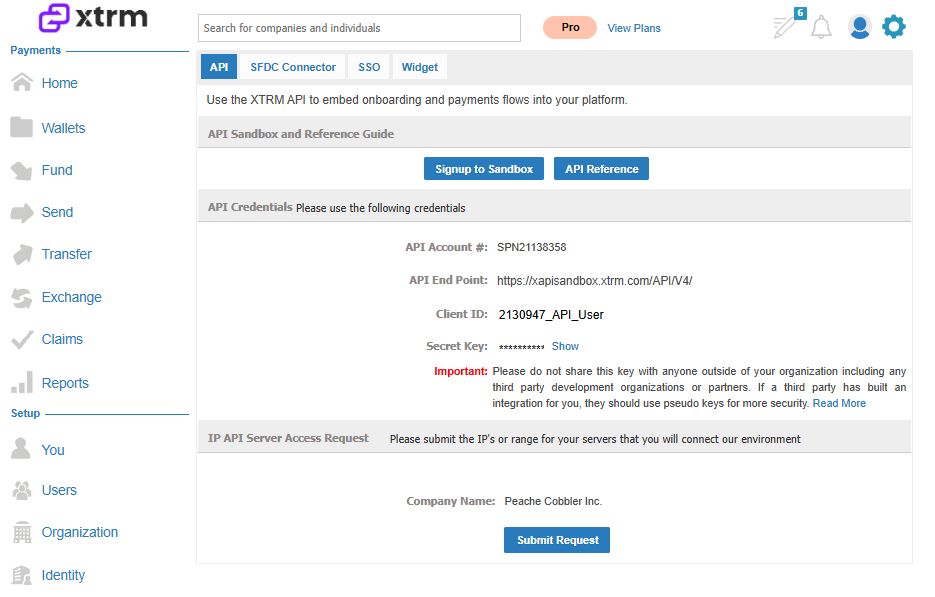
From this screen, you can get your API credentials and request access from whichever server(s) you'll be connecting to the Xtrm API listeners. Contact us at apisupport@xtrm.com and we'll approve your IPs — we'll then fund your sandbox company account with USD and EUR so you can start testing.
Sandbox environment (sandbox.xtrm.com)
The Sandbox environment is a complete replica of the Xtrm production environment, supporting the same API endpoints. Applications should be tested against the Sandbox environment before being used in production.
Differences from the production environment
The sandbox contains only test data and is completely separate from your production account.
Actual money is not sent or received as part of test transactions. Real financial data should never be used in the sandbox.
All API endpoints have a base URL of
https://xapisandbox.xtrm.com/API/V4/in sandbox, andhttps://xapi.xtrm.com/API/V4/in production.
Transfer behavior in the sandbox
The Sandbox environment does not make any payments, so a pending transfer will not be processed as it would in production — it simply remains pending indefinitely.
Sandbox setup
Once your IPs are approved, we'll add 250 USD and 250 EUR to two digital wallets in your account. Your company account dashboard is where you can view your API key and secret, and generate an OAuth access token.
Now you're ready — jump straight into the API docs.