TAX001 — Xtrm Global Tax Reporting Overview
Last updated: September 1, 2026
Xtrm advantages: global payments, simplified tax
Xtrm acts as a Third-Party Settlement Organization (TPSO) — the central hub for all transactions — which keeps tax reporting simple and compliant for everyone involved.
Clear payment source. Payments are processed through Xtrm, providing a transparent record for tax purposes.
No withholding tax at source. Recipients are responsible for reporting their own income, removing the need for complex withholding tax calculations.
Beneficiary responsibility. We supply recipients with the data they need to report their earnings to local tax authorities, including downloadable reports such as 1099-Ks (US) and equivalent documents.
Remitter reporting support. We provide reporting tools for remitting companies to comply with local tax regulations, and may handle reporting on your behalf in specific cases.
Seamless data collection. Xtrm electronically captures all relevant tax data, simplifying the filing process for all parties.
How Xtrm manages taxes
Understanding how Xtrm manages taxes helps explain how we're classified in the payments industry.
1. Xtrm as a Third-Party Settlement Organization (TPSO)
Xtrm sits between the remitter (paying company) and the beneficiary (receiving individual or company). As a TPSO, we're responsible for making payments to participating payees within a third-party payment network. This classification is defined by:
financial services being exempt from VAT (Value Added Tax)
a central organization with which a substantial number of unrelated providers of goods and services have established accounts
an agreement between the central organization and providers to settle transactions with purchasers
established standards and mechanisms for settling those transactions
a guarantee of payment in the settlement of those transactions
2. Payments processed through Xtrm
Payments to beneficiaries are identified as originating from Xtrm, regardless of whether the funds came from a third-party remitter.
3. No withholding tax at source
Recipients are typically not employed directly by your company — but even when they are, they're still responsible for reporting their income to their local tax authorities. Withholding tax is not required. Recipients declare "other income" and use data from reports like the 1099-K (USA) or equivalent documents to notify their tax authorities of applicable payments.
4. Beneficiary reporting responsibilities
Beneficiaries must report all income to their local tax authorities using the data and documents Xtrm provides. For example, in the US, individuals and companies can download their 1099-K and other relevant reports from their Xtrm account.
5. Remitter reporting (paying companies)
Xtrm provides the reporting remitting companies need to comply with IRS requirements. Reporting obligations vary by country and local regulation, and we may handle reporting on behalf of remitting companies in some cases, based on local rules and payment thresholds.
6. Data collection for tax reporting
We electronically capture all data needed to help companies and individuals file their taxes correctly for payments sent and received. This includes collecting W-9 and W-8BEN forms (or their international equivalents) and providing electronic access to 1099-Ks (USA) and other transaction reports.
Identity level requirements
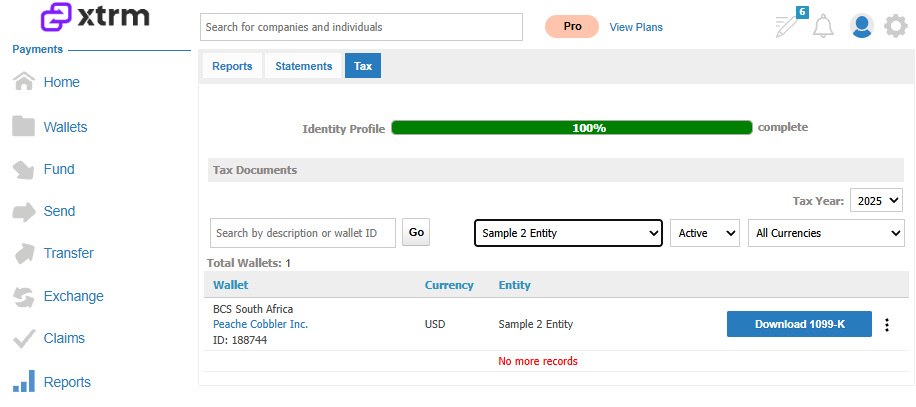
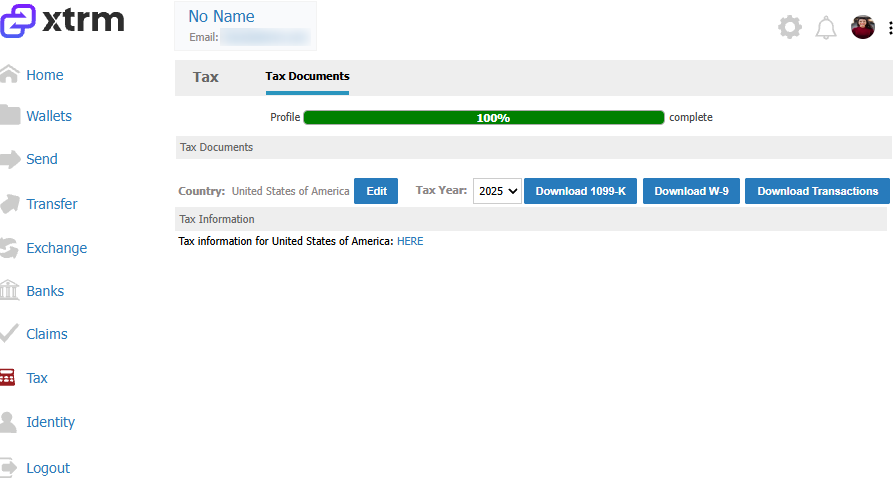
Your Identity profile must be at 100% complete IDL (Identity Level) to access and download your tax documents.
Company accounts — see Understanding Identity Levels and Limits for Companies (IDL) for how to reach 100% completion.
Individual accounts — see Adding Personal Information to Your Profile for how to reach 100% completion.
Advanced tax reporting: PLUS and PRO accounts
Want a more automated tax experience for your customers? A PLUS or PRO account enables automated creation, management, and delivery of country-specific formatted tax documents (e.g., 1099-K in the USA) directly to your beneficiaries.